
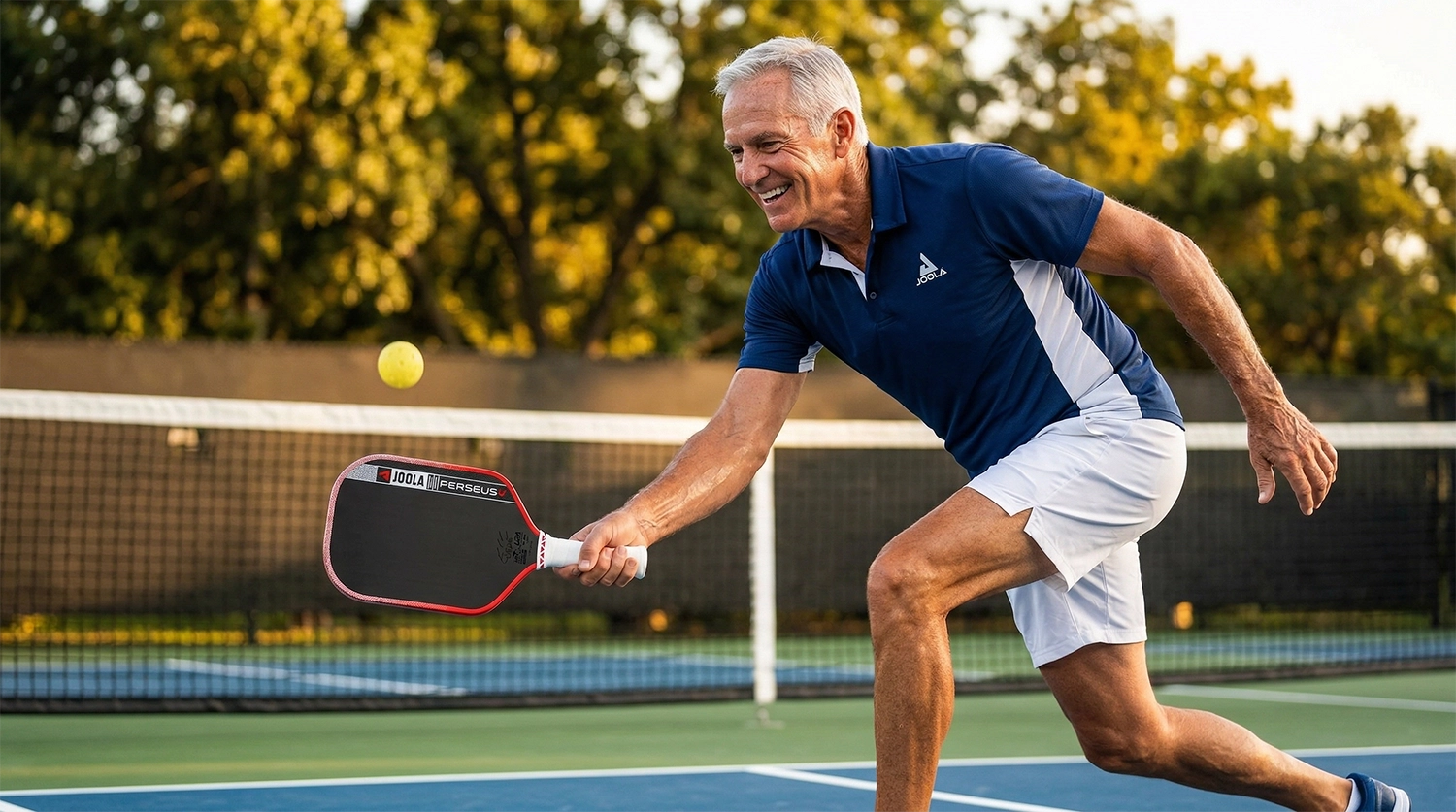
Pickleball Fitness Benefits for Seniors, The Ultimate Guide to Staying Active After 60
Pickleball fitness benefits for seniors go far beyond what most people expect when they first step onto the court, and the science behind those benefits is genuinely remarkable.
A sport that simultaneously delivers cardiovascular conditioning, balance training, cognitive stimulation, and genuine social connection is extraordinarily rare. Tennis does some of this, but the impact demands make it unsustainable for many players past 65. Walking delivers cardiovascular benefits but provides minimal coordination challenge. Pickleball does everything. In one place. With people you enjoy.
This guide breaks down the science of what pickleball actually does for your body and mind, the cardiovascular research, the balance evidence, the cognitive benefits, and the mental health data that explain why 70% of America’s 36 million pickleball players are over 50.
How Pickleball Conditions Your Heart After 60
The cardiovascular pickleball fitness benefits for seniors are among the most well-documented in current sports research.
A typical one-hour session keeps your heart rate elevated in the moderate-intensity zone, 60 to 75 percent of maximum heart rate, for the majority of the session. This is the range that cardiologists identify as optimal for cardiovascular conditioning in older adults. Intense enough to produce real training adaptations. Not so intense that recovery prevents frequent play.
Research published in the Journal of Aging and Physical Activity followed recreational players over 65 for six months. Results showed measurable improvements in VO2 max alongside significant reductions in resting heart rate and blood pressure, the markers that reduce risk of heart disease, stroke, and all-cause mortality.
The intermittent nature of the sport amplifies this effect. Points last 3 to 10 seconds, followed by brief rest periods between rallies. This interval-like structure produces cardiovascular conditioning that research shows is more effective for heart health than steady-state exercise at the same overall effort level.
Players who commit to three sessions per week consistently report improved daily energy levels, reduced fatigue, and better sleep quality within six to eight weeks, all downstream effects of improved cardiovascular fitness.
Balance Improvement and Fall Prevention
Falls are the leading cause of injury-related death among Americans over 65. Among the pickleball fitness benefits for seniors, the balance improvements may be the most practically significant for long-term independence.
Pickleball demands dynamic balance, the ability to maintain stability while moving, changing direction, and performing simultaneous motor tasks. During a typical rally you perform lateral shuffles, split-step landings, forward lunge movements, and rapid weight transfers, all while tracking a fast-moving ball and planning your next shot.
Each of these movements trains the exact neural pathways that prevent falls in daily life. Research shows that sports requiring multi-directional movement and visual tracking produce significantly better balance outcomes than single-plane exercises like walking or cycling.
A study examining older adult pickleball players found statistically significant improvements on standard balance assessment tests after just twelve weeks of twice-weekly play. Players consistently report feeling more stable in daily activities, on stairs, on uneven surfaces, and when recovering from unexpected slips.
The improvements are greatest in players who were sedentary before starting, but meaningful balance gains are documented even in already physically active players. The specific demands of pickleball, lateral movement, split-step anticipation, rapid directional changes, train balance systems that most other accessible sports do not challenge.
Cognitive Sharpness, The Brain Benefits You Did Not Expect
The cognitive pickleball fitness benefits for seniors are higher than most people realize. Every point involves rapid pattern recognition, real-time strategic adjustment, spatial reasoning, and split-second decision-making under physical stress.
These are precisely the cognitive functions that decline most rapidly with age in sedentary individuals, and precisely the ones that research shows can be maintained and improved through cognitive-physical challenge. Exercise that demands both physical and mental engagement simultaneously produces significantly greater cognitive benefits than physical exercise alone.
Neurological research on high-demand sports consistently shows that regular players demonstrate better processing speed, executive function, and working memory compared to age-matched controls who exercise but do not play cognitively demanding sports.
The social dimension amplifies these benefits further. You are communicating with partners, reading opponents, and managing the interpersonal dynamics of competition. Social engagement is one of the strongest known protective factors against cognitive decline.
Players consistently report improvements in mental sharpness and focus in daily life after taking up regular pickleball. This reflects measurable changes in the brain’s executive function networks that occur when you regularly engage those networks under moderate physical stress in a socially stimulating environment.
Social Connection, Belonging, and Mental Wellbeing
The mental health and social pickleball fitness benefits for seniors are inseparable from the sport’s structure, and that structure is genuinely unlike most other sports.
Pickleball courts create natural communities. The open play format means you are constantly meeting new players, forming partnerships with strangers, and participating in the light competitive camaraderie of recreational sport. For players who retired from careers with built-in daily social contact, this community dimension is often the primary reason they keep coming back, more than any of the physical benefits.
Social isolation is one of the most significant health risks for adults over 65, comparable in impact to smoking, according to research published in Perspectives on Psychological Science. The regular, built-in social interaction of pickleball directly addresses this risk in a way that solitary exercise cannot.
Beyond social connection, pickleball provides regular experiences of competence and achievement, mastering a new shot, winning a match you expected to lose, improving measurably week over week. These experiences are genuinely important for psychological wellbeing in retirement.
The fact that pickleball is genuinely fun is not a trivial point. It is the mechanism that makes all the other pickleball fitness benefits for seniors available across years of consistent participation. Activities you enjoy, you sustain. Activities you sustain, you benefit from long-term.
Playing Safely, How to Protect Your Joints Long-Term
To fully access the pickleball fitness benefits for seniors discussed in this guide, you need to protect your joints so you can keep playing long-term.
Tennis elbow is the most common pickleball injury and is entirely preventable. The three primary protective factors are equipment, technique, and recovery.
Equipment matters first. A paddle with a 16mm polymer core absorbs vibration that would otherwise reach your elbow on every contact. The difference between a quality carbon fiber paddle and a cheap wooden paddle is the difference between playing for years and developing tennis elbow within your first season.
Technique matters second. Compact, wrist-stable swing mechanics protect your elbow while also improving accuracy. Large, looping swings with excessive wrist snap generate both more errors and more joint stress.
Recovery matters third. Playing through arm pain is the fastest route to an injury that sidelines you for weeks, and weeks off the court means losing all the fitness benefits you have been building. Two to four sessions per week with recovery days between is the sustainable long-term approach.
When you are ready to choose the right equipment, our dedicated guide covers the specific paddles we recommend: Best Pickleball Paddles for Seniors 2026 →
How to Start Accessing Pickleball Fitness Benefits for Seniors at Any Age
Understanding the pickleball fitness benefits for seniors is the first step, starting is the second. Here is how to do it safely.
Begin with two sessions per week for the first month. Pickleball uses forearm muscles and shoulder stabilizers in ways that most daily activities do not engage, those muscles need progressive adaptation time before you play four or five times per week.
Start with a quality fiberglass or carbon fiber paddle from day one. Never use a wooden paddle, the vibration transmission is documented to cause elbow problems, and the performance is so inferior that it will discourage your development. A carbon fiber paddle at $60 to $72 protects your joints from session one.
Find open play sessions at local courts or recreation centers. USA Pickleball’s court locator at usapickleball.org helps you find courts and organized play in your area.
If you have existing joint concerns, consult your physician before starting. Most physicians actively encourage pickleball for patients over 60. The pickleball fitness benefits for seniors are well-recognized in the medical community, your doctor has almost certainly heard of the sport.
The Right Paddle, Your Most Important Equipment Decision
Every benefit discussed in this guide depends on one practical prerequisite: staying on the court. Staying on the court long-term requires protecting your joints, and that starts with your paddle.
A paddle with a 16mm polymer core and quality carbon fiber face is not a luxury purchase, it is a joint health investment. Premium paddle construction absorbs the vibration that causes tennis elbow, protecting the pathway that makes all pickleball fitness benefits for seniors accessible across years of play.
We have researched the best options available in 2026 and identified three paddles specifically for players focused on long-term sustainable play: Best Pickleball Paddles for Seniors 2026 →
FAQ 2026
What are the main pickleball fitness benefits for seniors?
The primary benefits are cardiovascular conditioning, improved balance and fall prevention, cognitive stimulation, and social connection. Research shows measurable improvements in VO2 max, blood pressure, balance scores, and psychological wellbeing in players over 65 who play two to four times per week.
How many calories does pickleball burn?
A typical one-hour recreational session burns approximately 400 to 600 calories, depending on intensity and body weight. The cardiovascular benefits are comparable to a brisk walk but with significantly greater coordination, cognitive, and social advantages.
Is pickleball safe for players with knee problems?
For many players with mild to moderate knee issues, pickleball is more sustainable than tennis because the court is smaller and movement demands are less extreme. Always consult your physician before starting with existing knee conditions.
How often should I play to see real fitness results?
Research suggests two to four sessions per week is the optimal frequency. This is frequent enough to produce measurable cardiovascular and balance improvements while allowing adequate joint recovery between sessions.
What is the best age to start?
There is no best age. Most new US pickleball players are between 55 and 75 when they start. Players who begin in their 60s and 70s regularly reach competitive recreational levels within their first year. Find local courts through usapickleball.org.
