
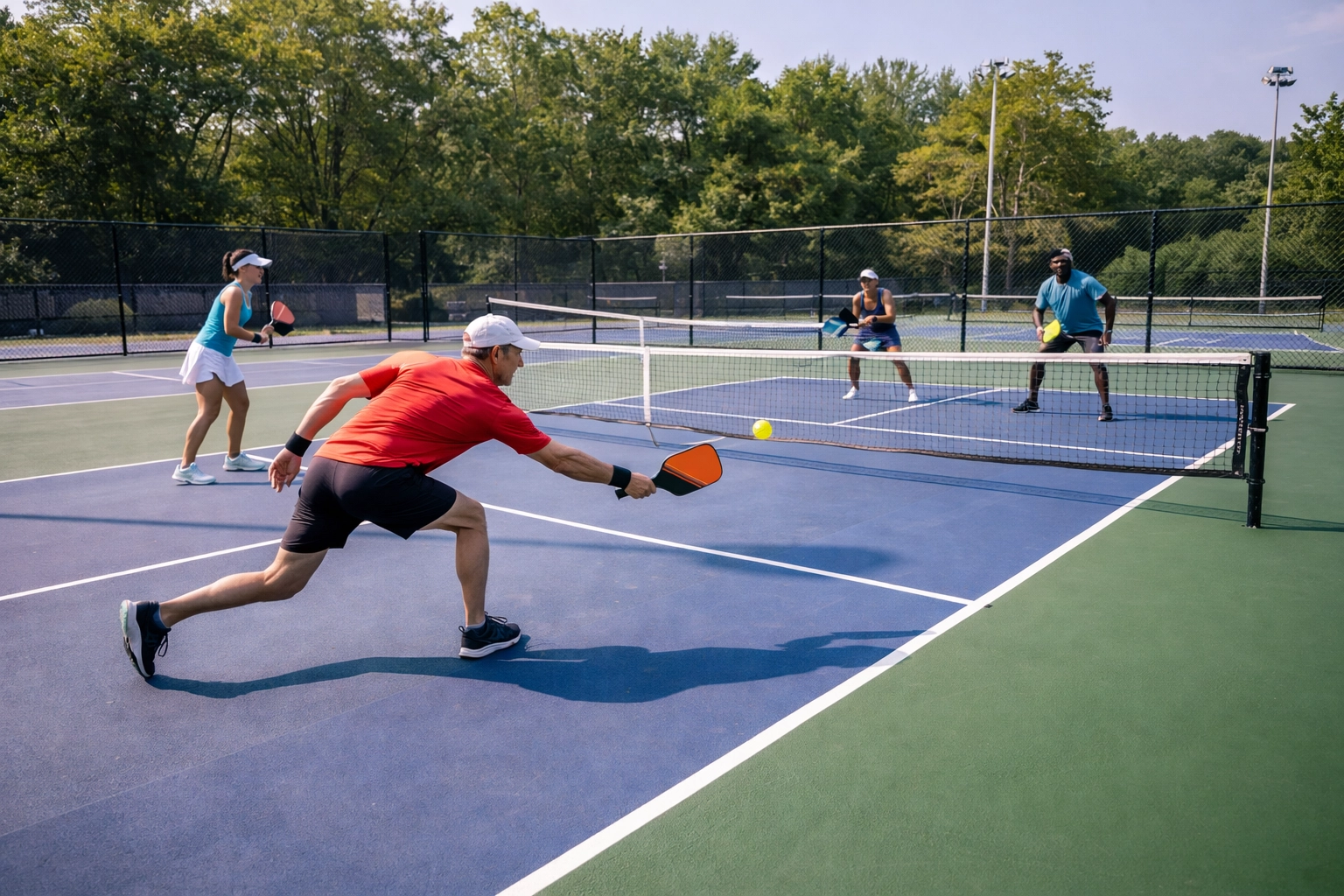
Pickleball seems to have shown up out of nowhere. Courts are popping up in parks near you, your friends are posting sweaty selfies with paddles, and there’s a decent chance your parents just joined a league. It’s now the fastest-growing sport in America, and it’s easy to see why: it’s social, it’s a solid workout, and unlike tennis or golf, you can actually hold your own after a single afternoon.
Watching a game for the first time is a different story. Why is everyone shouting three numbers before serving? Why can’t they step in that painted box near the net? And what’s with calling it “the kitchen”?
If the rules have kept you on the sidelines, this guide will clear that up. By the end, you’ll know enough to walk onto a court, hold your own, and understand exactly why everyone’s obsessed with this game.
What is Pickleball? (The “Explain Like I’m Five” Version)
Picture the love child of tennis, badminton, and ping pong.
Like tennis: hard court, a net, and scoring that feels genuinely competitive.
Like badminton: the court is roughly the size of a doubles badminton court, so there’s less running and more quick reflexes.
Like ping pong: a hard paddle, a plastic ball, and a game that lives and dies on hand-eye coordination.
What makes pickleball click is how approachable it is. The court is smaller than a tennis court (20 by 44 feet), so you don’t need marathon-runner stamina to cover it. Whether you’re 25 or 65, it’s easy to pick up and genuinely hard to master, which is exactly why people get hooked after their first point.
Gear Essentials: What You Actually Need to Get Started
One of the best things about starting out is how little you need to spend. That said, showing up with the wrong gear will make learning harder than it has to be.
The paddle: wood vs. composite
Walk into any sporting goods store and you’ll see paddles ranging from $15 to $250.
- Wood paddles: skip these if you can. They’re heavy, have zero “pop,” and can genuinely strain your wrist and elbow over time.
- Composite/graphite paddles: this is what you want. A decent composite honeycomb-core paddle in the $40–$60 range changes the game: lighter, better control, and a much better sound off the ball.
[Recommended Reading: The Best Pickleball Paddles for Beginners in 2026]
The ball: indoor vs. outdoor
Not all plastic balls are the same, and bringing an indoor ball to an outdoor court is a rough experience.
- Outdoor balls: 40 smaller holes, harder plastic built to handle rough surfaces and wind.
- Indoor balls: 26 larger holes, softer plastic made for gym floors. They crack quickly if you use them on concrete.
Court shoes: safety first
Please don’t play pickleball in running shoes. Running shoes are built for forward motion, and pickleball demands sudden lateral stops and starts. High foam heels plus quick side-to-side movement is basically a recipe for a rolled ankle.
Look for court shoes (tennis or volleyball shoes work fine) with a flat, durable sole and real lateral support. Your ankles will thank you later.
[Recommended Reading: Best Pickleball Shoes for Wide Feet & Comfort]
How to Hold a Pickleball Paddle
Before you set foot on a court, spend five minutes getting your grip right. A bad grip habit is hard to unlearn once you have played a few games, and it directly affects your control at the kitchen line.
The Continental grip (a.k.a. the handshake grip)
Hold the paddle out in front of you like you are about to shake hands with it, then wrap your fingers around the handle. This is the standard grip almost every player, including beginners, should start with, since it works equally well for forehands and backhands without needing to switch mid-rally.
The “V” check
A quick way to confirm you have it right: look at the V shape formed between your thumb and index finger. That V should point roughly toward your shoulder, not straight down the handle. If it is pointing somewhere else, rotate the paddle slightly until it lines up.
Grip pressure
Keep your grip relaxed, not clenched. Think of it on a 1-to-10 scale: about a 4 out of 10 for dinks and soft shots, closer to 7 out of 10 the instant you make contact on a hard drive. Squeezing at a 10 the entire time tires your forearm fast and kills the touch you need for dinking (more on that grip-pressure habit in Mistake 5 below).
If your hand size makes any grip feel awkward regardless of technique, the handle circumference itself might be the problem, not your form. Check our paddle grip size guide to find the right fit.
The Court Layout Explained
A standard pickleball court is 20 feet wide by 44 feet long. The net sits at 36 inches on the sides and dips slightly to 34 inches at the center.
The one part of the court that trips up almost every beginner is the Non-Volley Zone, better known as the Kitchen. It’s the 7-foot strip on both sides of the net, and it works like a no-fly zone for volleys.
The 5 Golden Rules of Pickleball
What are the pickleball rules, really? You don’t need to memorize a 50-page rulebook. Five rules will get you through your first game.
Rule 1: The Serve
- Underhand only: contact with the ball has to happen below your waist (specifically, below the navel).
- The diagonal: you serve diagonally into the opponent’s service box.
- Feet placement: keep at least one foot behind the baseline when you strike the ball.
- No “let” serves: if the ball clips the net and still lands in the correct box, play continues: it’s a live ball.
For the complete official rules, visit USA Pickleball.
Rule 2: The Two-Bounce Rule
This is the one that trips up tennis players the most.
- Bounce 1: the receiver has to let the serve bounce before returning it.
- Bounce 2: the serving team has to let the return bounce before hitting it.
Once those two bounces happen, it’s open season: volley it or play it off the bounce, your call.
Rule 3: No Volleys in the Kitchen
You can’t volley while standing in the Kitchen or touching its line. If your momentum carries you in right after a volley, that’s a fault.
Exception: you can step into the Kitchen to play a ball that’s already bounced.
Rule 4: Line Calls
- Lines are in: a ball hitting the sideline or baseline counts as in.
- Kitchen line exception: on the serve, a ball landing on the Kitchen line is out. Benefit of the doubt always goes to the opponent.
Rule 5: Faults
Common faults: hitting the ball out of bounds or into the net, volleying from the Kitchen, and volleying before the ball has bounced once on each side.
How Scoring Works (Simplified)
Scoring trips up more beginners than anything else on this list, but it clicks fast once you’ve played a game.
The basics
- Games go to 11 points, win by 2.
- You can only score when your team is serving.
The three-number score
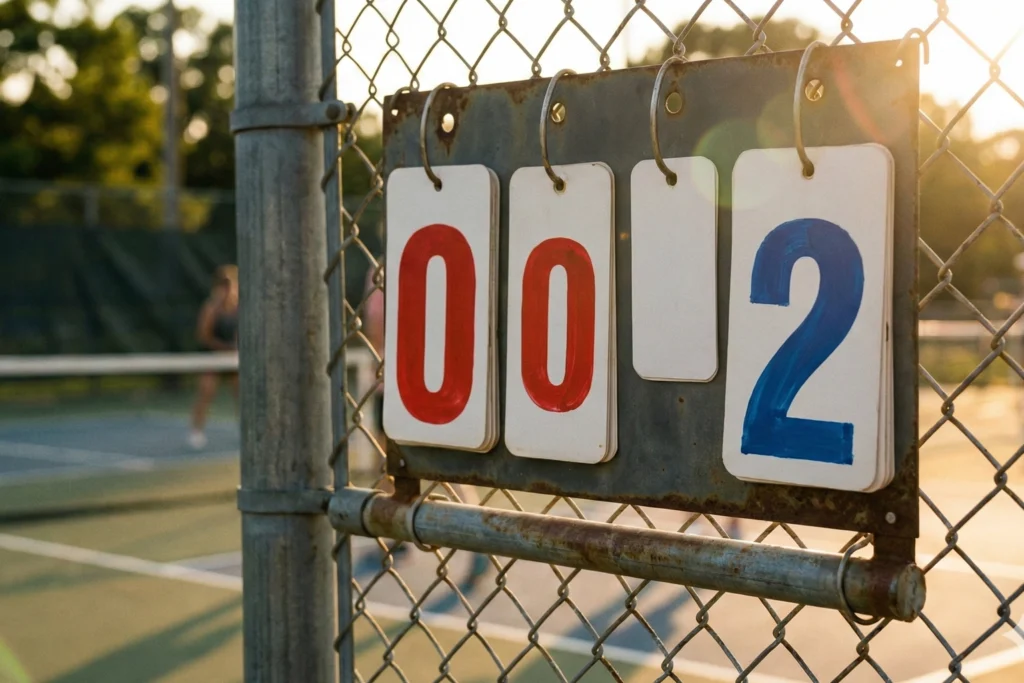
In doubles, you call out three numbers before every serve. Say, “4–2–1.”
- First number (4): the serving team’s score.
- Second number (2): the receiving team’s score.
- Third number (1): which server is up, 1 or 2.
Server 1 and Server 2
Each player on a team gets a turn serving before the ball passes to the other team. Once Server 2 loses a rally, it’s a side out, and serve switches teams.
One exception: at the very start of the game, only one player on the first team serves, so the score opens at 0-0-2 instead of 0-0-1. It keeps things fair from the opening point.
Singles vs. Doubles: Key Differences
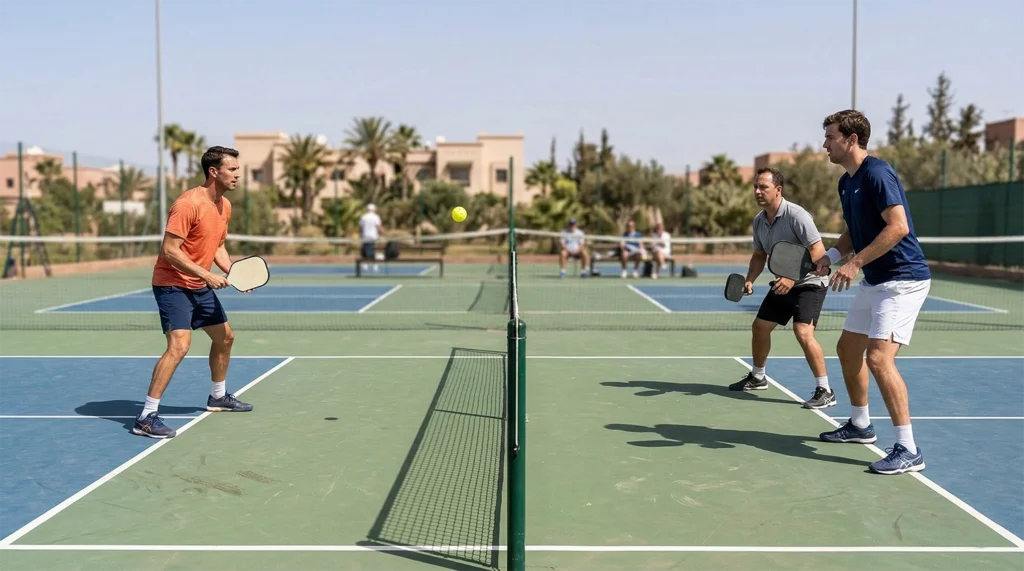
Around 90% of pickleball is played as doubles, but singles is a genuinely tough workout.
- No “Server 2”: lose the rally in singles and serve goes straight to your opponent.
- Positioning: serve from the right side on even scores (0, 2, 4) and the left on odd scores (1, 3, 5).
- Strategy: rush the Kitchen line in doubles; in singles, hang back a bit more to cover the open angles.
[Read our full Singles vs Doubles Guide]
Your First Game: What to Expect
The warm-up: most casual games open with a couple minutes of dinking back and forth from the Kitchen line. Don’t skip it: it wakes up your hands and gives you a feel for the ball before points start mattering.
Open play rotation: most public courts run a paddle queue: you set your paddle on the fence or in line, wait for a court to open, and rotate in once a game ends. Winners stay, losers rotate out. If you’re unsure how a specific court handles it, just ask; people are happy to explain.
Your first few points: you’ll step into the Kitchen when you shouldn’t. You’ll lose track of the score. You’ll probably volley before both bounces have happened. All of that is completely normal. Every experienced player made the exact same mistakes on day one.
The one rule that matters most on day one: don’t over-apologize. Call the score loudly and confidently, and if you get it wrong, someone will correct you gently. Pickleball courts have a well-earned reputation for being welcoming to beginners, so use it.
5 Beginner Mistakes to Avoid
Knowing what not to do speeds things up just as much as knowing the rules. These five mistakes show up in nearly every new player.
Mistake 1: Standing too far back. New players gravitate toward the baseline out of instinct. In pickleball, the team that gets to the Kitchen line first usually wins the point. Move forward.
Mistake 2: Hitting every ball hard. Power isn’t the strategy here: placement and patience are. Players who smash every shot (“bangers”) are easy to beat once you learn to reset with soft dinks. Control wins over power at every level.
Mistake 3: Poaching your partner’s shots. Stay on your side. New doubles players often cross over to grab a ball that belongs to their partner and leave their own half wide open. Trust your partner and cover your lane.
Mistake 4: Avoiding the Kitchen entirely. Beginners get so cautious about the volley rule that they stay out of the zone even when the ball has already bounced and it’s completely fine to step in. Use that space when you can.
Mistake 5: Gripping the paddle too tight. A death grip kills your touch and tires your forearm fast. Aim for something closer to 4 out of 10 grip pressure on dinks and 7 out of 10 on drives: firm enough to control the paddle, loose enough to absorb pace.
Your First Game Awaits
You now know the rules, the gear, the scoring, and the strategy, everything you need to walk onto a court with confidence.
Before you head out, use our guide to [find a pickleball court near you], covering the 7 best free tools for finding a court in 2026.
Don’t stress about being perfect on day one. You’ll step into the Kitchen when you shouldn’t, forget the score, and probably volley too early at least once. It happens to everyone.
The community is genuinely welcoming, and experienced players are usually glad to help during open play. Grab a paddle, find a local court, and see what all the fuss is about.
How to Play Pickleball: FAQ
Q: How long does a pickleball game last? A casual game to 11 points usually takes 15–25 minutes. Tournament games to 15 or 21 points can run 30–45 minutes.
Q: Can I play pickleball alone? Not really: you need at least one opponent. You can practice solo against a wall to work on dinks, drives, and consistency; many dedicated facilities have practice walls for exactly this.
Q: How is pickleball different from tennis? The court is about a quarter the size, the serve is underhand, you can’t volley in the Kitchen, and only the serving team scores. The slower ball and smaller court make it far more accessible for beginners and gentler on the joints.
Q: What’s the most important skill for a beginner to learn first? The dink, a soft shot that clears the net and drops into the opponent’s Kitchen. It sounds basic, but it’s the foundation everything else builds on.
Q: Do I need to be fit to play pickleball? Not at all. The smaller court means less running than tennis, and players across every fitness level, from competitive athletes to seniors with limited mobility, play together comfortably.
Q: Is pickleball hard on your knees? It’s noticeably lower-impact than tennis or running. The smaller court cuts down on explosive sprinting, and the underhand serve removes the shoulder strain of an overhand motion.
Q: What score do you start with? Doubles games start at 0-0-2, not 0-0-1: this gives the receiving team a fair start by limiting the first serving team to a single server. Singles games start at 0-0.
